
.png)
.png)
Empowering amputees
for a better life
FUTURE ABOVE-THE-KNEE PROSTHETICS
Modern lower limb prosthetics offer advanced mechanics and control, yet many users still face issues with cost, comfort, reliability, and everyday usability. High-end solutions remain heavy, expensive, and difficult to adapt to different lifestyles, while simpler prostheses often lack flexibility and long-term support. This gap affects access, confidence, and sustained use.
This thesis explores how modular design, emerging fabrication methods, and a system-level approach can improve functionality while keeping prosthetics accessible and intuitive. The work prioritizes ease of use, comfort, and real-world performance, while leaving space for future robotic assistance without making it the core focus. The aim is a lower limb prosthetic system that supports daily life first,
and progresses over time.
MFA Degree Project
ArtCenter College of Design
Duration: 20 Weeks
2025
01
RESEARCH
Background

85% of all limb losses are
lower limb amputations.

Global surge in diabetes and an ageing
population is significantly increasing
the demand for lower limb prosthetics.

Up to 60% of amputees experience depression or anxiety after limb loss. Emotional trauma is just as real as the physical loss.
Industry
The prosthetics industry chases high-end bionic systems to protect margins.
Most lower limb solutions focus on technology, not daily impact.
- Advanced prosthetic legs cost $40,000 to over $100,000.
- Insurance companies drive purchasing decisions, not users.
- Added features often bring small gains in comfort or function.
- Day-to-day life for amputees changes very little.
Progress has stalled where it matters most.
Ease of use. Comfort.
Long-term adaptability.
If prosthetics must become bionic, the direction needs to be rethought.
- Can loss become a starting point for new capability?
- Can a prosthetic offer functions beyond an average human leg?
- Can this be done without pricing users out?

Industry
Almost all the options look:
Mechanical
Lack of personalization
Unattractive
Alien to the outfit

Interviews and findings
Interview panel consisted of:
4 Industry professionals
14 Lower-limb amputees.
The interviews highlighted three consistent issues with existing prosthetics.

Takes about 5-7 min to wear and take off

Sweating inside the socket is very frustrating

Never matches their outfit
02
IDEATION
Design opportunity
As a result of primary and secondary research, I decided to create a set of solutions specifically divided into 3 steps.


Socket design
Leg module 01
Leg module 02
Deriving inspiration from the recent robotics design language to introduce familiar surfacing.


Ideation
I explored different concepts via sketching and prototyping and validated ideas with users and experts.
.jpg)
03
FINAL DESIGN

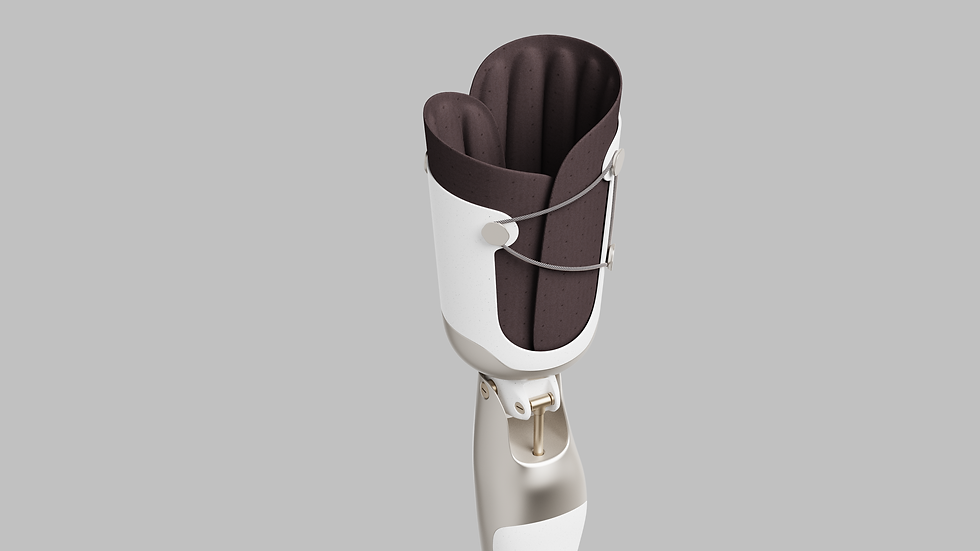
The current design concept is focusing on the socket design, since no one is spared from residual pain. It offers features like a cooling pad designed with breathable materials and fast adjustability for a more comfortable lifestyle on the go.
Cooling pads
The socket combines breathable fabric with localized, on-demand cooling.
Cooling activates only when discomfort begins, targeting pressure-heavy areas.
Power remains external and optional, keeping the system lightweight and simple.


Instant adjust
A dial-based closure from BOA enables fast, one-handed fitting and removal. The fit adjusts in seconds, even while standing or seated, drastically reducing setup time to around 10 secs and improving daily usability.

Design opportunity
As a result of primary and secondary research, I decided to create a set of solutions specifically divided into 3 steps.

CMF
It comes with 3 different CMF to offer range of options for your style.

Prosthetics designed to make you feel proud of what you carry around. Something an amputee would love to show off.


Physical model
Finally, I built a physical design model to validate and showcase the visual appearance of the prosthesis.
More prototypes in progress...


